
A cookie exchange works like this: everyone bakes a big batch of one kind of cookie, and everyone goes home with a mix of all of them. The question every host gets is how many to bake, and the answer is one formula: number of bakers × cookies per person. With 8 bakers and 6 cookies each, every baker brings 48 cookies, or 4 dozen. Below you’ll find the math for every group size, house rules to post, invitation wording and a two-hour plan. For coordinating printables, see The Cookie Tin party kit.
The short version
- Each baker brings bakers × cookies per person (count yourself).
- 6 per person once you pass 8 bakers; a dozen each for 6 or fewer.
- Early-December weekend afternoon, about two hours.
- Labels with allergens, a recipe card and a container to take cookies home.
How a cookie exchange works
Each guest bakes one kind of cookie in a large batch, and the batches are shared out so everyone leaves with an assortment.
The host sets the number, the date and the rules; guests claim a cookie on a sign-up so nobody brings the same one. Most of the party is tasting, chatting and boxing up.
- Pick the date: an early-December weekend afternoon.
- Set the count: bakers × cookies per person, written in dozens.
- Invite with a sign-up: each baker claims one kind, so there are no repeats.
- Label every plate: cookie name, baker and allergens.
- Swap: go around the table in rounds until every platter is shared out.
- Vote (optional): a few categories and a small award for each.
How many cookies should each person bring?
The formula
Each baker brings (number of bakers) × (cookies per person). Add an optional dozen for a tasting plate.
Count every baker, including yourself, so everyone leaves with the same mix, including a share of their own cookie. If you’d rather nobody takes their own cookie home, use the number of bakers minus one. Either way, put the final number on the invitation in dozens, so the math is done for your guests too.
Cookie math by group size
| Bakers | Each brings at 6 per person | Each brings at 12 per person | Everyone takes home |
|---|---|---|---|
| 6 | 36 (3 dozen) | 72 (6 dozen) | 6 kinds: 6 or 12 of each |
| 8 | 48 (4 dozen) | 96 (8 dozen) | 8 kinds: 6 or 12 of each |
| 10 | 60 (5 dozen) | 120 (10 dozen) | 10 kinds: 6 or 12 of each |
| 12 | 72 (6 dozen) | 144 (12 dozen) | 12 kinds: 6 or 12 of each |
| 15 | 90 (7½ dozen) | 180 (15 dozen) | 15 kinds: 6 or 12 of each |
Example: 8 bakers × 6 per person = 48 cookies (4 dozen) each, and everyone goes home with 48 cookies, 6 of each of 8 kinds.
Why the advice online varies
You’ll see two common rules: a dozen per guest, or about half a dozen. Both are fine; they just suit different group sizes. A dozen per person is easy with five or six bakers, but with ten bakers it means ten dozen cookies each. We recommend 6 per person once you have more than 8 bakers.
Big groups (12 or more)
- Lower the count to 4 to 6 per person: with 12 bakers that’s 48 to 72 cookies each.
- Bake in pairs: two friends share one kind and split the batch.
- Split into two tables of six to eight, each with its own swap.
Pick the date, time and length
An early-December weekend afternoon works for most groups; in 2026 that’s Saturday, December 5 or Saturday, December 12. Plan for two hours: about 45 minutes to arrive, taste and vote, then the swap, then packing up. Send invites three to four weeks ahead so people can plan a baking day.
Invitation wording you can copy
For friends at home
You're invited to a cookie exchange! Saturday, Dec 12, 2:00 to 4:00 pm [Address] Bake one kind of cookie and bring 4 dozen (that's 48). Claim your cookie on the sign-up so we don't double up: [link] Please bring a recipe card, a label listing any allergens, and a container to take cookies home. RSVP by Saturday, Nov 28.
For the office
Office cookie exchange: Thursday, Dec 17, 12:00 to 1:00 in the break room. Bring 2 dozen of one kind (homemade or bakery, both welcome), individually wrapped or in bags of 2. Claim your cookie on the sign-up: [link] Please list allergens on your label. We'll have boxes for taking cookies back to your desk. Sign up by Thursday, Dec 10.
Cookie exchange rules (a house-rules sign)
Keep the list short enough to read from across the room, and put the same rules in the invitation.
- One kind of cookie per baker, claimed on the sign-up.
- Bring the agreed number, in dozens.
- Homemade or store-bought: the host decides and says so here.
- Label your cookie with its name, your name and its allergens.
- Bring a recipe card (or be ready to text the recipe).
- Bring a container or tin to take cookies home.
- Taste before you vote. Vote once per category.
Labels and allergies
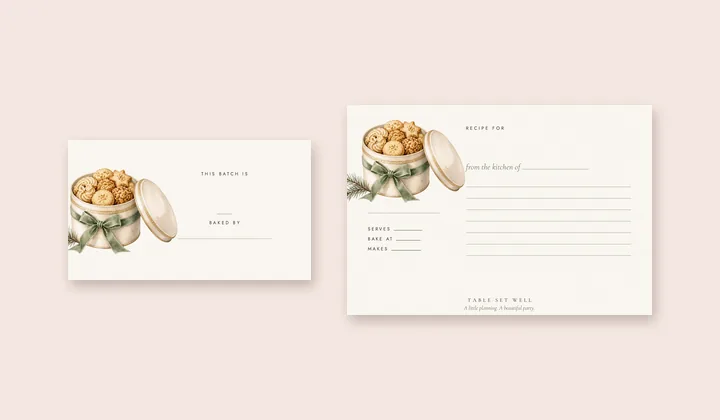 Product preview
Put one label in front of every platter with the cookie’s name, the baker and what it contains.
The FDA lists nine major food allergens: milk, eggs, fish, crustacean shellfish, tree nuts, peanuts, wheat, soybeans and sesame, which became the ninth on January 1, 2023 (FDA: sesame, the ninth major food allergen). The kit’s cookie labels have space for the cookie name and baker. Add any allergens on a separate card beside the plate and on your own take-home packaging note, including soy or sesame when needed. Keep cookies with nuts on their own plate with their own tongs, and when in doubt, ask the baker.
Set up the swap table
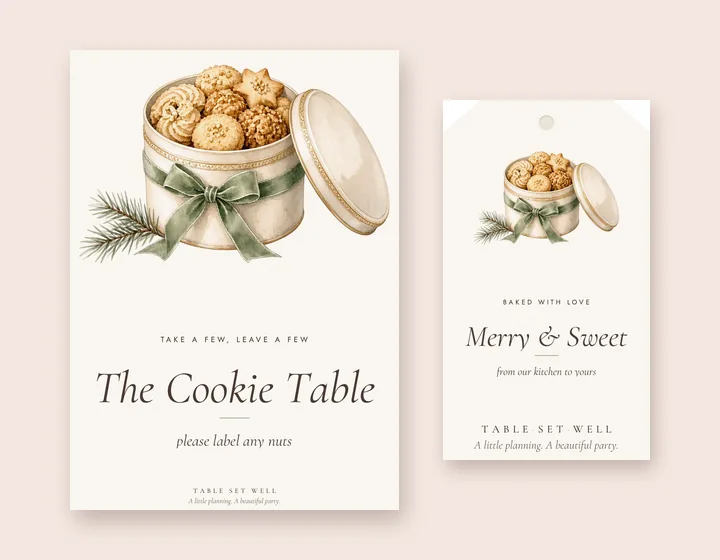 Product preview
- Platters in a row, each with its label in front and a number for voting.
- Containers at the end: a stack of boxes, tins or bags, plus parchment and take-home tags.
- A ballot box and pens by the door.
- Drinks on a separate table, away from the cookies.
For packaging, bags of two or boxes lined with parchment keep cookies from breaking, and a label or note with the cookie’s name and what it contains goes on every box. Soft and crisp cookies keep better in separate containers.
Run of show for a two-hour party
| Time | What happens |
|---|---|
| 0:00 | Arrivals. Cookies go straight onto the swap table with their labels; coats off; drinks. |
| 0:15 | Tasting plate opens and ballots go out. |
| 0:45 | Voting closes. Someone counts while everyone refills drinks. |
| 1:00 | The swap: go around the table in rounds, taking the agreed number of each cookie. |
| 1:30 | Awards. |
| 1:45 | Pack up: tags on boxes, extras shared out, recipe cards swapped or photographed. |
Games and awards
Keep it to three or four categories so voting takes minutes, not an hour: most festive, best classic, most creative and best in show. Small awards (a ribbon, a card, first pick at next year’s swap) work better than anything that costs money.
Running a cookie exchange at work
- No oven needed: cookies arrive baked and packaged.
- Use a lunch hour, and book the room.
- Check your workplace’s food rules first.
- Label everything with allergens, and ask for cookies wrapped individually or in small bags.
- Lower the count: 2 dozen each is plenty for a team of 12.
Add the coordinating details
A coordinating cookie swap kit
The Cookie Tin includes a welcome sign, cookie labels, recipe cards, Cookie Detective activity cards, menus, favor tags and matching TV art. The kit is a digital download, so nothing ships, and you can print the pages at home or at a local print shop. See the printing and download questions and our personal-use license.
Hosting Christmas dinner too? Our guide to hosting Christmas dinner has the full plan.
FAQ
How many cookies should each person bring to a cookie exchange?
Multiply the number of bakers by how many cookies you want each person to take home of every kind. With 8 bakers and 6 cookies per person, each baker brings 48 cookies, or 4 dozen, and everyone leaves with 6 of each kind. For small groups of 6 or fewer, a dozen per person works. For groups of 12 or more, drop to 4 to 6 per person so each baker’s batch stays around 4 to 6 dozen.
Do you count yourself when figuring out how many cookies to bake?
Yes. Count every baker, including yourself, so each person goes home with the same assortment as everyone else, including a share of their own cookie. If you’d rather keep none of your own, use the number of bakers minus one. Either way, put the exact number in dozens on the invitation so nobody has to work it out.
What are the rules for a cookie exchange?
Keep the rules short and put them in the invitation: bake one kind of cookie, claimed on the sign-up so there are no repeats. Bring the agreed number, plus a few for tasting if the host asks. Label your cookie with its name and any allergens such as nuts, dairy, eggs or gluten. Bring a recipe card and a container to take cookies home. Whether store-bought cookies are allowed is the host’s call, so say so up front.
How long should a cookie exchange last?
About two hours is plenty: 45 minutes or so to arrive, taste and vote, then the swap, awards and packing up. At work, a lunch hour is enough if the cookies arrive already packaged.
Can people bring store-bought cookies to a cookie exchange?
It’s the host’s call. Some groups keep it homemade; others welcome bakery cookies so nobody skips the party for lack of time. Whatever you decide, put it in the invitation and on the house rules sign.
What if someone cancels at the last minute?
Leave the math alone. Everyone just goes home with one fewer kind. If you know a day or two ahead, tell the group so nobody over-bakes for a guest who isn’t coming, and keep a box of good bakery cookies as a backup for the tasting plate.
Whatever wins best in show, everyone goes home with a box worth sharing.