Choose holiday party invitations by deciding what kind of gathering you are hosting, then checking that the same design carries through to the printed details you will actually use. Start with the invitation, one useful table piece and a clear plan for printing. A basket of decorations you still have to coordinate can wait.
The short version
- Choose holiday party invitations around the gathering, not just the illustration.
- Check matching printable place cards, menus and signs before committing to a design.
- A coordinated kit saves design decisions, but it still needs editing, printing and trimming.
- Keep digital invitations and printable party kits as two separate purchases in your planning.
How do you choose holiday party invitations and matching table details?
The gathering first, the design second, the printed pieces third. A seated dinner needs different details from a drinks party, even when both invitations wear the same evergreen wreath.
- Write one plain sentence describing the party: dinner with family, cocktails with friends or an afternoon cookie swap.
- Choose an invitation whose mood supports that sentence.
- Check the coordinating kit before personalizing the invitation.
- Pick the pieces with a job: helping guests find, serve or enjoy something.
- Test one printed page before preparing the whole set.
Browse our Christmas digital invitations with those answers in hand. The useful question is not which design is prettiest on its own, but which one belongs at the party you have the room, and the energy, to host.
Why the invitation comes first
An invitation is a small promise. It tells guests whether to expect a sit-down meal, a casual drop-in or an evening that calls for the good shoes. The wording does most of that work; the design sets the tone around it.
Starting with that promise also puts a fence around the decorating. You do not need a new table. A familiar tablecloth, everyday plates and a few printed details belong together perfectly well when they share one clear direction.
For your 2026 holiday gatherings, make the plan practical before you make it elaborate. Decide where guests will eat, where the coats will go and whether food is served at the table or from a counter. Then choose the details that help those spaces work.
Match the design to the way you are gathering
The right invitation makes the occasion clear without asking guests to decode it. A playful design can carry precise dinner information; a restrained one can still welcome children. Never leave the artwork to say something the words should say directly.
| Gathering | Best for | Useful printed details | What to avoid |
|---|---|---|---|
| Seated holiday dinner | Hosts planning a shared meal | Place cards and a menu | Crowding each setting with pieces guests must move |
| Cocktail evening | Friends gathering for drinks and small bites | Drinks menu and dish cards | An invitation that implies a full dinner |
| Cookie exchange | Guests bringing something to share | Cookie labels and a welcome sign | Decorative copy crowding out the exchange instructions |
| Relaxed family afternoon | Mixed ages and flexible arrivals | A welcome sign and selected food labels | An unclear arrival window |
If everyone already knows your home and the group is small, a welcome sign is optional. If everyone serves themselves, dish cards earn their place before individual menus do. Hosting a swap? Our guide to how to host a cookie exchange covers the rest.
For dinner, let the invitation set the table
A seated meal gives printed details a natural home. Start with what guests read when they sit down: their name, the menu or both. Choose a design that reads clearly against your own napkins and plates, rather than one that demands a whole new setting.
A gentle botanical behaves differently from a bold cocktail illustration, but neither requires a themed room. Repeat one color in a ribbon or napkin if you like, then leave the rest of the table alone. Planning the meal itself? See how to host Christmas dinner.
For drinks, give the serving area the spotlight
At a standing party, the bar cart or kitchen counter works harder than any place setting, so put the printed pieces there. A drinks card tells guests what is being poured; dish cards identify the food.
Before sending a 2026 invitation, read it as a guest deciding whether to eat beforehand. If you are serving appetizers rather than dinner, say so. One clear sentence does more for a comfortable evening than another decorative flourish.
Check the matching kit before you choose the invitation
Matching should mean the pieces belong together, not that you must use every one. Open the kit page and read the contents rather than assuming every design includes the same items.
- Does the kit include the menu, place cards or signs you need?
- Which pieces have fillable fields, and which are fixed designs?
- Does the download suit your paper and printer?
- Is the invitation a separate purchase?
- Which pieces need trimming or folding after printing?
- Is any included artwork meant for a screen rather than paper?
These are buying questions, not finishing touches. Discovering you need a different format after preparing your guest list adds exactly the work you were trying to avoid.
Table Set Well pairs holiday party invitations with matching printable party kits, for at-home hosts who want the invitation and the table to follow the same design. You still choose the pieces, personalize the relevant fields and handle the printing yourself. The invitation is a digital purchase sent to guests online; the kit is a printable download. Nothing ships.
A Christmas dinner example
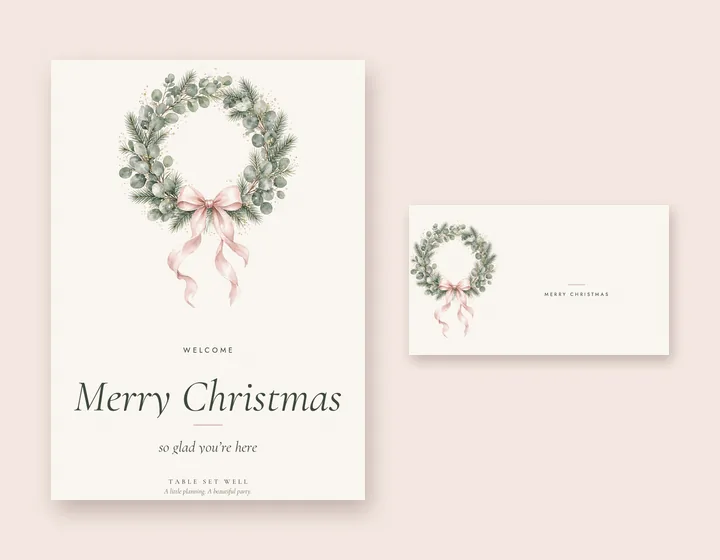 Product preview
The Ribbon Wreath kit pairs a pine-and-eucalyptus wreath with a blush silk bow. Its listed contents include a welcome sign, folded place cards, dish cards, a Signature Sips and menu page, and favor tags, among other pieces, with fillable fields on selected items. The matching invitation is sold separately.
For a seated dinner, you might use the place cards and menu, then stop. If guests are taking something home, add the favor tags. The collection gives you options; it does not oblige you to fill every surface.
A relaxed evening example
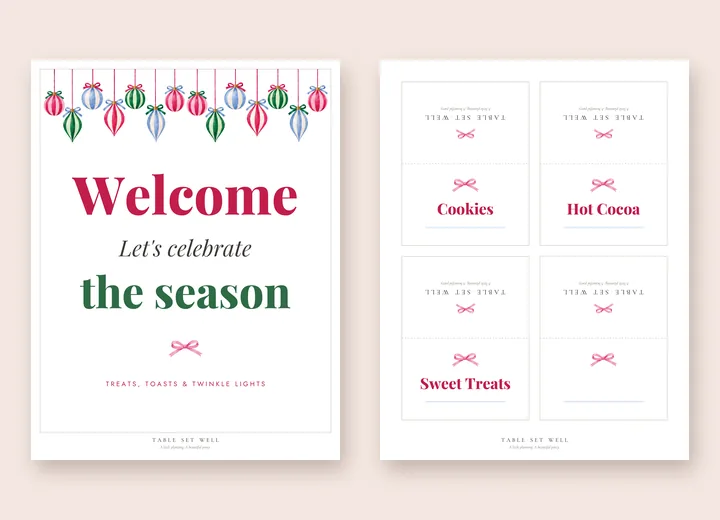 Product preview
Merry Little Party includes a welcome sign, folded place cards, dish cards and a Signature Sips card beside the menu. It also includes matching TV artwork, which is for a digital display, not for printing. Here too, the invitation is sold separately.
For an appetizers-and-drinks evening, the dish cards and drinks card are a sensible start. Place cards matter less when nobody has an assigned seat. Keep the design consistent and let the party itself stay relaxed.
A coordinated kit, or individual pieces?
Both can make a handsome table. The difference is where you spend your effort: selecting pieces that already belong together, or finding and checking separate designs yourself.
| Approach | Best for | Main advantage | Main limitation |
|---|---|---|---|
| Coordinated invitation and kit | Hosts who want one design direction | Fewer separate design choices | Printing and assembly are still yours |
| Individual printable templates | Hosts who enjoy mixing stationery | Freedom to choose each piece | Fonts, colors and formats need checking together |
| Invitation with existing table decorations | Hosts keeping printed details minimal | Uses what is already at home | No matching guest-facing paper pieces |
A coordinated collection helps when the decision-making is the tiring part. Separate templates suit a host who enjoys comparing details and is happy to do the matching. And if you already love your table, an invitation alone is a perfectly reasonable choice.
Why your printed-piece list varies
The useful pieces depend on what guests need to do, not on the size of the download. A kit can hold more than your gathering calls for and still be the right choice.
- Serving style: a buffet benefits from labels; a seated meal gives a menu somewhere to live.
- Guest familiarity: clear signs help most when visitors do not know the space.
- Seating: assigned places make name cards useful; open seating does not need them.
- Food information: labels identify dishes, but they do not replace an accurate conversation about ingredients.
- Preparation time: folding and cutting compete with shopping, cooking and setting the table.
Keep your 2026 plan small enough to finish comfortably. If a piece has no job, leave it in the download folder. Coordinating the pieces you use matters more than displaying every piece provided.
Check printing before you prepare the whole party
A screen preview is not a printed proof. Before editing every name, print one sample using the instructions supplied with the download.
The kits described here specify US Letter paper printed at 100% / Actual Size. Their fillable PDFs can be personalized in free Adobe Acrobat Reader or printed blank and completed by hand. Follow the instructions for each file, and check your printer’s paper limits before choosing heavier stock.
- Print one sample page before duplicating it.
- Check the print setting against the file instructions.
- Trim or fold one piece completely.
- Set it where guests will use it, and check that the text reads well.
- Correct the file or printer setting before printing the rest.
For a 2026 dinner with 8 named places, make sure the final file contains all 8 names before printing (an example, not a required guest count). Check spelling against the guest list rather than memory, and label the final version clearly so an earlier draft never reaches the printer. More questions? See printing and download help.
Keep invitation details and table details in sync
A matching illustration cannot fix conflicting information. If the invitation describes a cocktail evening, the menu should not leave guests wondering whether dinner was meant to appear. If the format changes, review the guest-facing wording as well as the shopping list.
Before sending your 2026 invitations, check the event name, date, start time, location and response instructions together. For any optional activity, say what guests should bring, and put longer instructions where guests can find them without crowding the card.
Once replies arrive, use the confirmed guest list for place cards, and finalize menus and dish labels against what you will actually serve. The invitation sets the plan; the printed pieces should reflect the plan you are now carrying out.
FAQ
Do holiday party invitations and place cards need to match exactly?
No. A coordinated collection makes matching simpler, but a shared palette and readable wording can also connect an invitation with pieces you already own.
Should I choose holiday party invitations before decorations?
Choose the gathering first, then the invitation and any matching printed pieces. That gives your remaining decorating choices a direction without requiring a new table setting.
Which printable pieces matter most for a seated Christmas dinner?
Place cards and a menu are useful starting points for a seated Christmas dinner. Add other pieces only when they have a job, such as identifying buffet dishes or labeling a take-home favor.
Are matching invitations included with Table Set Well party kits?
No. The Ribbon Wreath and Merry Little Party kit pages state that the invitation is sold separately. Check the individual invitation and kit pages before purchasing.
One clear invitation, a few pieces with a job, and a table that already feels like yours.